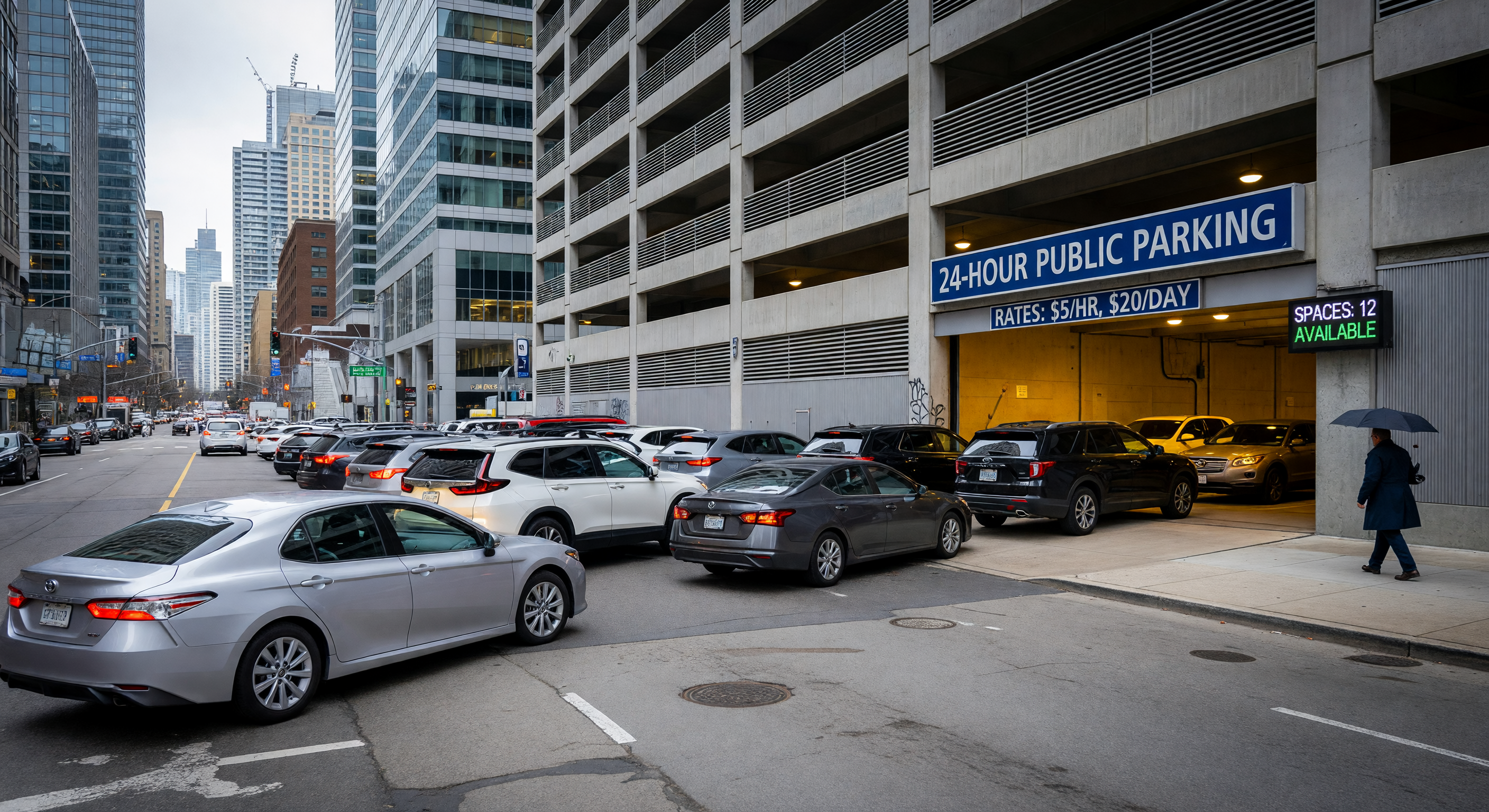
The most common entry lane mistake in parking facility design isn’t underbuilding — it’s underbuilding for the wrong scenario. Operators size their lanes for average demand, then get blindsided by the one Friday night a month when a concert lets out and vehicles stack halfway to the street. The math to prevent this isn’t complicated. It’s called D/D/c queueing theory, and it’s the right tool for any facility with predictable, high-intensity arrival bursts.
What D/D/c Actually Means
Queueing theory models how waiting lines form when demand and service capacity interact. The notation “D/D/c” comes from Kendall’s classification system — the shorthand parking operators should know:
- First D (arrival process): Deterministic arrivals. Vehicles arrive at a known, uniform rate. In burst scenarios — concert discharge, stadium exit, morning rush at a gated garage — arrivals cluster tightly enough to treat as uniform.
- Second D (service process): Deterministic service time. Each transaction (ticket dispense, credential scan, payment) takes a predictable fixed time. With modern automated lanes, this is highly consistent.
- c (number of servers): The number of entry lanes operating simultaneously.
Together, D/D/c models the worst-case queue: what happens when a known arrival surge hits a fixed number of lanes. No randomness, no luck — just the math of throughput vs. demand rate.
Why Burst Events Demand a Different Model
Most queueing models assume random arrival patterns — the classic M/M/c (Markovian arrivals, Markovian service) is standard for general retail and service environments. But parking entry during a burst event doesn’t behave randomly.
When a 10,000-seat arena event ends, the parking structure attached to it will receive a high percentage of its 3,000 vehicles within 15–20 minutes. Arrivals aren’t Poisson-distributed — they’re bunched, roughly uniform, predictable within a window. That’s the D/D/c scenario.
The key insight: in a D/D/c model, a queue forms the moment your arrival rate exceeds your service rate, and it grows linearly until the burst ends. There’s no statistical relief from random spacing. If your lanes can process 60 vehicles per hour per lane and 120 vehicles arrive per hour, two lanes are the exact threshold — three lanes gives you headroom, one lane produces a guaranteed and growing queue.
The Calculation: Arrival Rate vs. Service Rate vs. Lane Count
The core relationship is straightforward:
Minimum lanes required = Arrival rate ÷ Service rate per lane
To apply it you need three inputs:
1. Peak arrival rate (λ): How many vehicles per hour arrive during your burst window? For events, this is your facility’s vehicle count divided by the discharge window (typically 15–30 minutes after event end). A 500-car structure with 20-minute post-event discharge runs approximately 1,500 vehicles/hour equivalent — for that window.
2. Service rate per lane (μ): How long does each entry transaction take? Typical rates by lane type:
- Ticket-on-entry (thermal ticket dispense): 8–12 seconds → 300–450 vehicles/hour
- Credential readers (RFID, LPR): 4–6 seconds → 600–900 vehicles/hour
- Pay-on-entry with cashier: 20–45 seconds → 80–180 vehicles/hour
3. Queue tolerance: How long a backup is acceptable? Even with adequate lanes, a 5-minute burst will produce a temporary queue. D/D/c lets you calculate exactly how deep that queue gets and how long it takes to clear.
If your peak λ is 900 vehicles/hour and your lanes process 450 vehicles/hour each, you need exactly 2 lanes to prevent the queue from growing. Three lanes means every burst clears with capacity to spare.
Applying This to Facility Planning
For facilities that see regular burst demand — stadiums, arenas, convention centers, airports, campus structures at shift change — D/D/c planning should drive lane count decisions, not average daily volume.
The questions to answer before committing to a lane count:
What is your worst-case burst window? Not the average event, the largest event your facility will ever serve. Size to that.
What is your lane service rate — measured, not assumed? Equipment spec sheets give theoretical throughput. Real transaction times include vehicle approach, credential fumbling, and gate cycle time. Measure during a busy period or ask your equipment vendor for real-world benchmarks from comparable installs.
What queue length is operationally acceptable? If vehicles backing up 10 deep will block an adjacent street, that’s your constraint — not just the math.
Are your lanes homogeneous? Mixed lane types (one credential-only lane, two ticket lanes) require modeling each lane separately. A single slow lane in a mixed configuration can anchor the whole queue if vehicles choose sub-optimally.
The seasonal demand parking planning framework is a useful complement here — it helps you identify which events and time periods actually drive your peak demand, so you’re sizing to the right scenario. For airport facilities specifically, airport parking operations covers the arrival pattern characteristics that make D/D/c modeling particularly valuable for that vertical.
LPR and Credential Readers Change the Math Significantly
The service rate variable is where modern access technology makes the biggest difference. A ticket-dispense lane at 10 seconds per vehicle processes 360 vehicles/hour. An LPR camera reading a plate at 3–4 seconds processes 900–1,200 vehicles/hour — more than triple the throughput from the same physical lane.
This isn’t theoretical. Facilities that have replaced ticket lanes with LPR-based entry have effectively doubled their lane capacity without adding infrastructure. The capital cost of one additional lane — construction, equipment, permitting — typically exceeds the cost of upgrading two existing lanes to LPR credential processing.
When you’re running a D/D/c analysis for a renovation or new build, always model the service rate you’ll actually achieve with the technology you’re planning to deploy. Assume ticket dispense and you’ll overbuild lanes. Assume LPR and you may be able to reduce them. The parking control equipment guide covers how equipment selection affects throughput in more detail.
What D/D/c Won’t Tell You
D/D/c is a best-case analysis tool — it tells you the minimum lanes required when arrivals are perfectly uniform and service time is perfectly consistent. Real facilities have variance: drivers who stall, credentials that misread, vehicles that pull up crooked to a reader.
For facilities where arrival patterns are genuinely random (transient downtown garages, hospital outpatient, retail), M/M/c models are more appropriate. They account for the statistical clustering and gaps that reduce peak stress compared to the uniform-arrival assumption.
Use D/D/c when:
- You have a defined burst window (event end, shift change, class dismissal)
- Arrivals are dense enough to treat as uniform
- You want a conservative (worst-case) lane count estimate
Use M/M/c when:
- Demand is continuous and random throughout the day
- There’s no single dominant burst event
- You want to model steady-state average queue length
For facilities with both patterns — a university garage that has steady daytime use plus post-game surges — model them separately and plan for the binding constraint.
Sizing Right the First Time
Entry lane count is one of the few facility design decisions that’s very expensive to change later. Adding a lane to an existing structure means construction, utility work, and potentially reconfiguring the entire entry approach. Getting the analysis right before the building permit is filed matters.
Parking BOXX designs entry systems for facilities across North America that span the full range of demand scenarios — from low-volume access-control-only installs to high-throughput event venue entries processing thousands of vehicles per discharge window. If you’re in the planning phase of a new facility or a major renovation, our barrier gate systems page covers the equipment options and throughput specifications that feed directly into your D/D/c analysis. The right conversation to have is about your specific burst scenarios — not just which gate arm looks right.