Knowing how full your parking lot is in real time sounds straightforward. The reality is that occupancy sensing involves several competing technologies, meaningful installation costs, and ongoing data integration work. For operators evaluating whether sensors make sense, the question is less about which technology is best in isolation and more about which one fits your facility type, budget, and what you plan to do with the data.
The Three Main Sensor Technologies
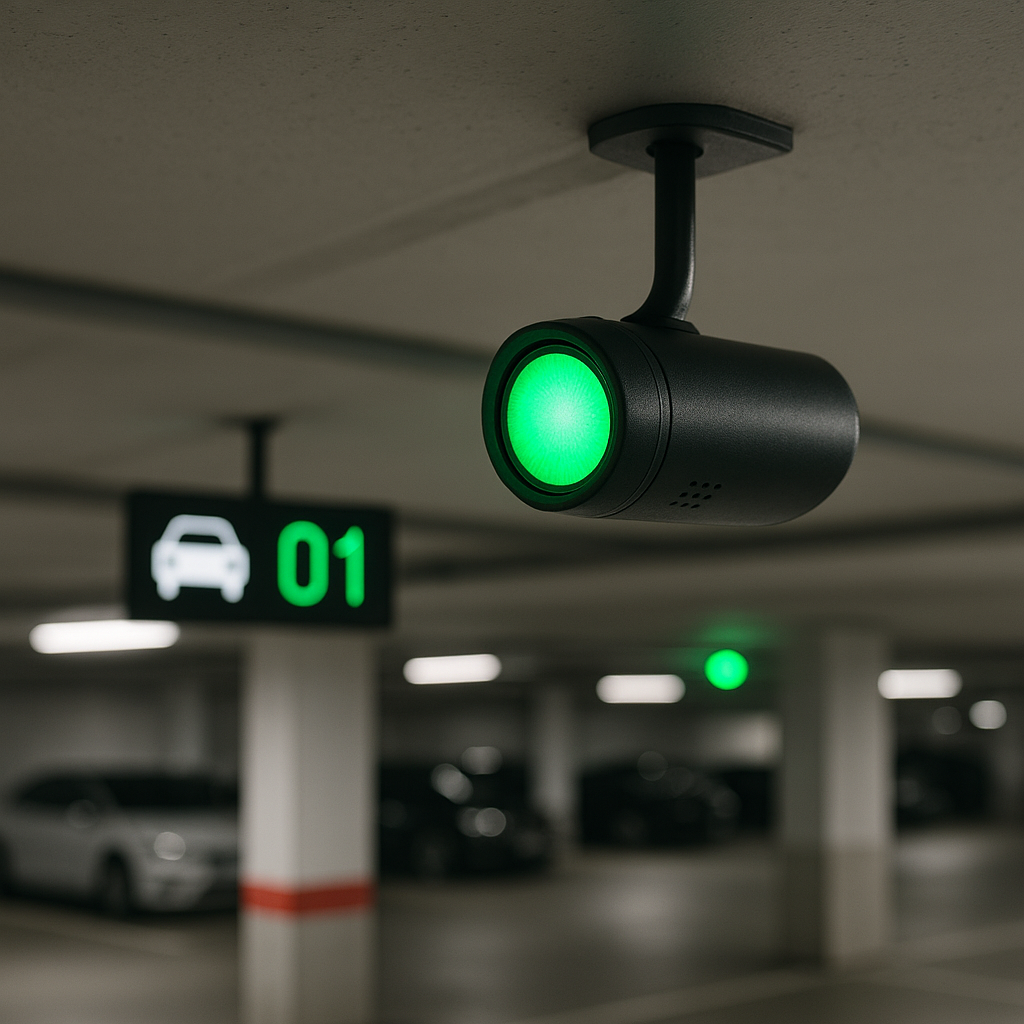
Ultrasonic sensors are mounted overhead in covered facilities — typically on the ceiling of each stall in a structured garage. They emit sound waves downward and detect whether a vehicle is present by the reflected response. Ultrasonic sensors are reliable in controlled indoor environments, typically accurate to 97%+, and relatively affordable per unit. The limitation is that they require a powered mounting point above each space, which makes them impractical for open surface lots without overhead infrastructure.
Camera-based systems use either per-stall cameras or wide-angle cameras covering multiple spaces, with computer vision software interpreting vehicle presence. Modern AI-powered camera systems can detect occupancy, read license plates, and track dwell time simultaneously. They’re versatile enough for both surface lots and garages and require fewer mounting points than per-stall ultrasonic units. The tradeoff is higher per-unit cost, more complex software infrastructure, and the need for adequate lighting at night. The parking monitoring system category increasingly centers on camera-based platforms that bundle occupancy with access control and security functions.
Magnetic sensors are embedded in or placed on the pavement surface beneath each stall, detecting the magnetic signature of a vehicle above them. They work outdoors in all weather conditions and don’t require overhead infrastructure. Installation is more disruptive (pavement cutting or surface-mount adhesion) and battery-powered wireless units need periodic replacement. Accuracy is high — close to ultrasonic — but the per-space installation cost can be significant for large lots.
How Sensor Data Feeds Guidance Systems
Raw occupancy data becomes valuable when it feeds a real-time guidance system that communicates availability to drivers. In garages, this typically means LED count displays at each entry level showing available spaces by zone. On larger campuses or in urban areas, the same data can feed external signage, mobile apps, or integrated navigation platforms.
The guidance system chain requires more than just accurate sensor data. You need a reliable data aggregation layer, a display or app integration, and a refresh rate fast enough to reflect real-time conditions (sub-30-second updates are the standard). Operators who invest in sensors without planning the guidance layer end up with occupancy data that sits in a dashboard few people check.
ROI Considerations: When Sensors Make Sense
Occupancy sensors are not universally cost-effective. For a 50-space surface lot charging $5/day flat rates, the data doesn’t generate enough revenue uplift to justify a $20,000+ sensor deployment. For a 500-space multi-level garage where search traffic congestion is a documented problem, or where dynamic pricing depends on real-time occupancy, the math changes substantially.
Strong ROI cases include: garages where drivers routinely circle looking for spaces (increasing congestion and customer complaints), facilities where dynamic pricing is in use or planned, university and hospital campuses where occupancy across zones varies sharply, and any operation where live occupancy data feeds pre-booking systems.
Before purchasing any sensor system, define what decisions you’ll make with the data. If occupancy visibility will change how you price, staff, or communicate availability to customers, sensors are a tool with measurable payback. If you’re buying them because they seem like a reasonable technology investment without a specific use case, the ROI will be harder to realize. See our guide on calculating parking ROI from automation for a broader framework on evaluating technology investments.