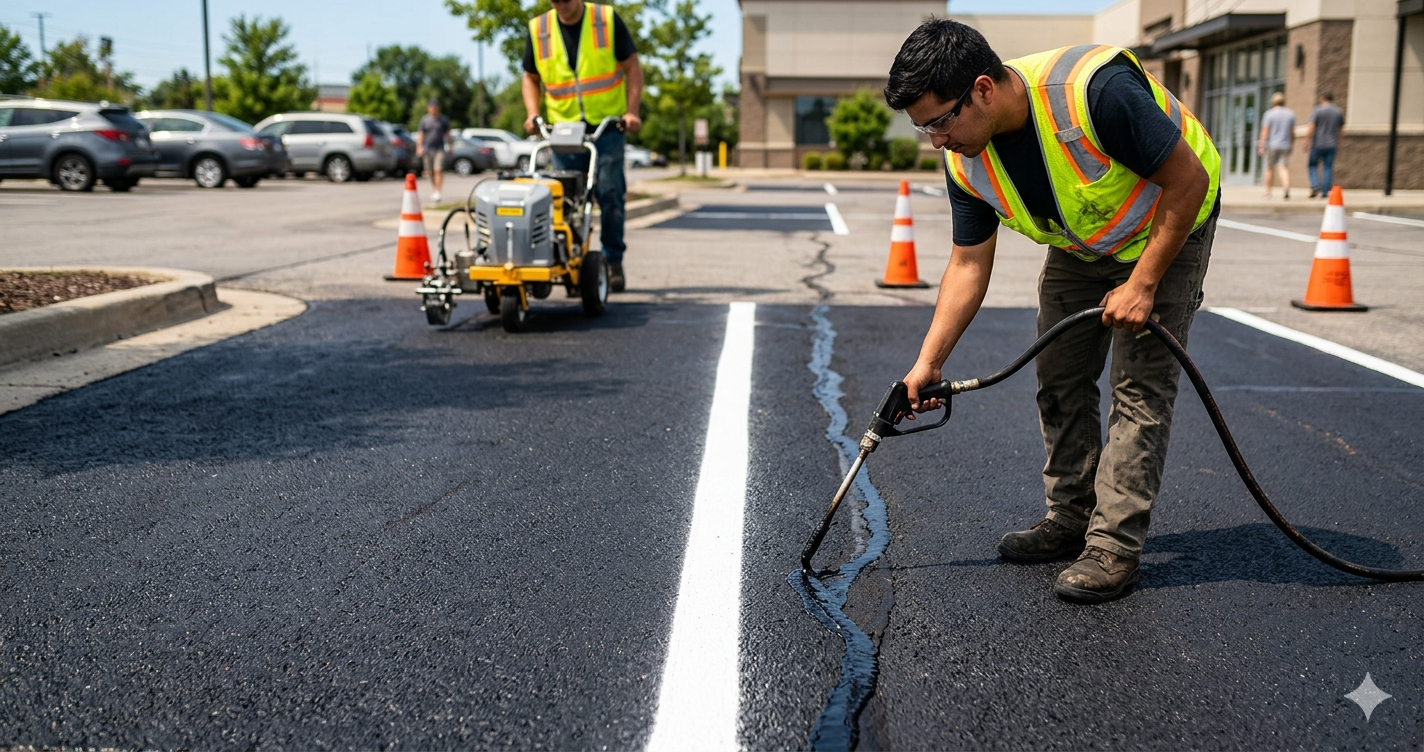
Asphalt is the single most expensive asset in most surface parking lot operations, and it deteriorates predictably. Operators who understand the maintenance cycle and invest at the right intervals keep their lots functional and attractive for 25–30 years at a fraction of the cost of premature full-depth replacement. Operators who defer maintenance until distress becomes severe face reconstruction costs that are three to five times higher than proactive maintenance would have been.
Understanding the Pavement Maintenance Hierarchy
Pavement deterioration follows a well-documented curve: new asphalt holds up well for several years, then begins showing surface cracking, followed by deeper structural cracking, then raveling, potholing, and base failure. The cost to arrest deterioration rises steeply as distress progresses. The correct intervention depends entirely on where in this curve your pavement is.
Crack sealing is the first line of defense. Fine hairline cracks in asphalt are inevitable within 3–7 years of installation due to thermal cycling and UV oxidation. When cracks are still narrow — less than 1/2 inch wide and without significant edge crumbling — routing and sealing with hot-applied rubberized sealant prevents water infiltration that leads to base failure. Crack sealing a lot in good overall condition costs $0.10–0.25 per linear foot. It is the highest ROI maintenance activity available.
Sealcoating is a surface treatment that applies a protective layer over the entire asphalt surface, restoring color, sealing surface voids, and slowing oxidation. It does not add structural strength. Sealcoating is appropriate for pavement in good to fair condition — if your lot has significant structural cracking or base failure, sealcoating over it is an aesthetic fix that doesn’t address the underlying problem. Sealcoat every 3–5 years as part of a regular maintenance program.
Mill and overlay (resurfacing) removes the top 1.5–2 inches of deteriorated asphalt and replaces it with new material. This is the appropriate intervention when surface distress is moderate to severe but the base is still intact. Cost runs $1.50–3.00 per square foot — substantial, but far less than full replacement.
Full-depth reclamation or reconstruction is required when the pavement base has failed — typically indicated by alligator cracking, significant settling, or drainage problems. This is a $3.00–6.00+ per square foot project and represents a failure of the maintenance program to intervene earlier. Good parking lot layout planning includes drainage design that extends pavement life by preventing water from saturating the base.
Budgeting for the Asphalt Lifecycle
A properly maintained surface lot has a pavement lifecycle budget that looks approximately like this over 25 years:
- Years 1–5: Crack seal as needed ($500–2,000 total)
- Year 5–7: First sealcoat application ($0.08–0.15/sq ft)
- Years 8–10: Second sealcoat application
- Years 12–15: Mill and overlay ($1.50–2.50/sq ft)
- Years 15–18: Sealcoat application post-overlay
- Years 20–25: Second sealcoat cycle, then full reconstruction at end of life
Build a pavement reserve fund — a regular monthly allocation into a capital reserve specifically for lot pavement — based on the replacement cost of your pavement divided by the expected life. An operator who sets aside $3,000–5,000 per year for a mid-size lot will never face a $150,000 reconstruction bill as an unexpected capital event.
Pothole Liability and Winter Damage
Potholes create slip/trip hazards for pedestrians and vehicle damage claims from drivers. The liability exposure is straightforward: if you knew or should have known about a dangerous condition and failed to remediate it, you are exposed. Document your pavement inspection schedule and repair log carefully. A pothole reported and repaired within 48 hours represents a very different liability profile than one that existed for three months.
Winter damage accelerates pavement deterioration because water infiltrates cracks, freezes, expands, and widens those cracks. De-icing chemicals — particularly chloride-based products — also accelerate oxidation and damage concrete surfaces. Inspect pavement carefully each spring after snowmelt and perform crack sealing before the next winter cycle. For seasonal operational planning that coordinates pavement maintenance with winter readiness, see our guide on seasonal demand and parking planning.