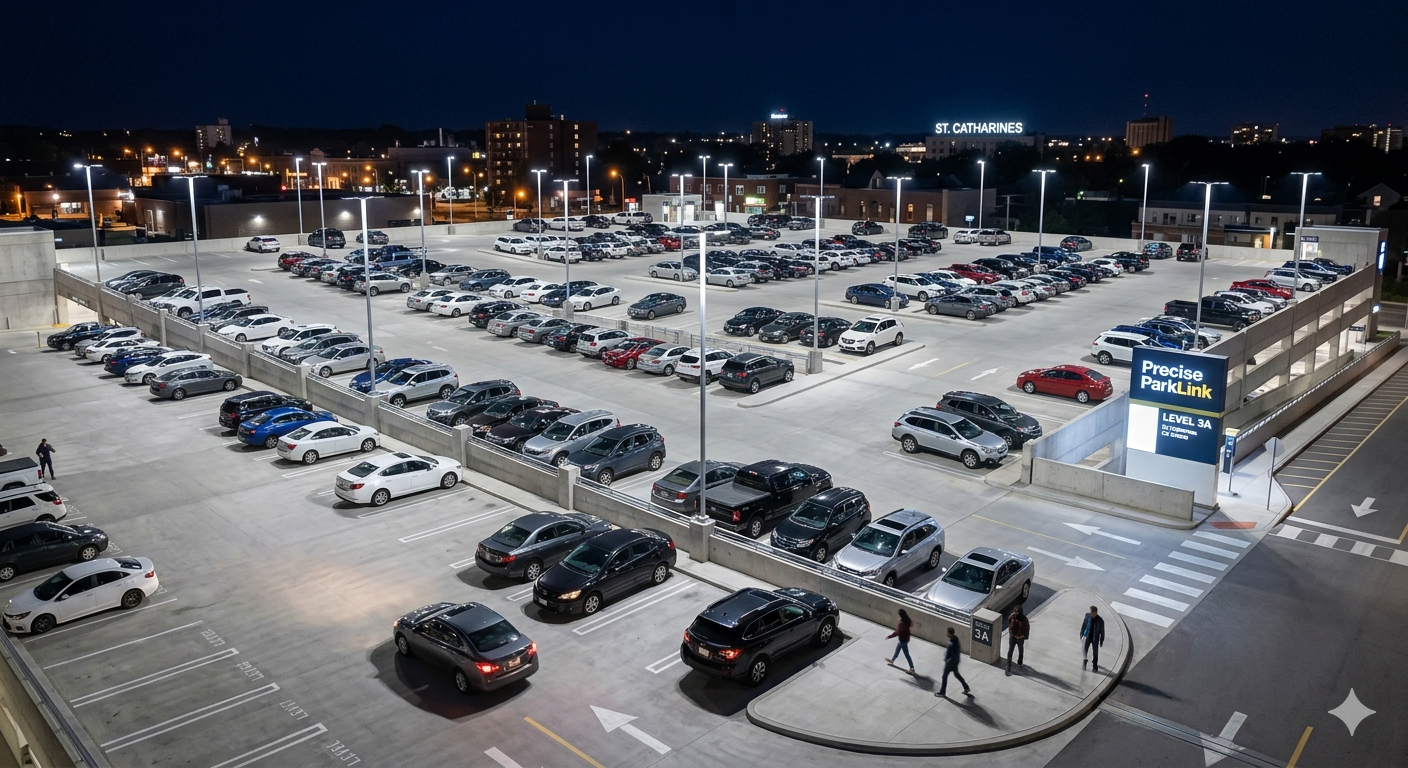
Parking lot lighting affects three things that matter directly to operators: safety, liability, and operating cost. Under-lit lots generate more incidents, expose operators to negligence claims, and push drivers to better-lit competitors. Over-lit lots waste energy and in some jurisdictions create regulatory exposure from light trespass or dark sky ordinances. Getting lighting right is an engineering and operational decision worth making deliberately.
IES Recommended Footcandle Levels
The Illuminating Engineering Society (IES) publishes lighting recommendations for parking facilities in RP-20, the standard reference for the industry. Key thresholds:
Open surface lots:
- General parking area: 0.2–1.0 maintained footcandles (fc) minimum, with 1.0 fc recommended for higher-security facilities
- Entrance and exit lanes: 5.0 fc recommended to ease adaptation from exterior street lighting
- Stairwells, pedestrian walkways: 5.0 fc minimum
Parking garages (enclosed):
- General parking decks: 5.0 fc minimum during daytime, 1.0 fc minimum nighttime
- Entrance ramps: 50 fc during daytime hours (to ease bright exterior to dim interior transition)
- Stairwells, elevator lobbies: 10.0 fc minimum
These are maintained averages — the actual design levels must be higher to account for light depreciation over the fixture life. A system designed at exactly 1.0 fc will fall below standard before the first bulb replacement cycle.
Lighting uniformity matters as much as average level. A uniformity ratio of no worse than 4:1 (maximum to average) is the IES standard for parking areas. Dark spots between fixtures create zones where the average looks adequate but individual locations are unsafe for pedestrians.
A well-maintained parking monitoring system that includes camera coverage works significantly better in facilities that meet or exceed these lighting standards — cameras in under-lit lots produce footage that is often unusable as evidence.
LED Retrofit ROI and Practical Payback
LED technology has transformed the economics of parking lot lighting. A typical 400-watt metal halide fixture replaced with a 150-watt LED fixture reduces energy consumption by 62% while delivering equivalent or better illumination levels. At $0.12/kWh with fixtures running 12 hours per night, a single fixture saves approximately $66 per year in electricity alone.
A 100-space surface lot typically has 15–20 pole fixtures. At 17 fixtures and $66 annual savings per fixture, electricity savings alone run approximately $1,100 per year. LED fixtures also last 50,000–100,000 hours versus 15,000–20,000 hours for metal halide, dramatically reducing maintenance labor and lamp replacement costs.
Total cost of LED retrofit for a 100-space surface lot runs $15,000–$40,000 depending on pole condition, fixture selection, and electrical work required. Payback periods of 5–8 years are typical on energy savings alone, with maintenance savings frequently shortening that to 3–5 years.
Utility rebate programs in most markets reduce upfront cost by 20–40%. Contact your utility before finalizing a retrofit project — rebates are frequently contingent on specific fixture specifications and pre-approval before installation begins.
Dark Sky Compliance and Motion Sensor Strategies
International Dark-Sky Association (IDA) compliant fixtures — and increasingly, local ordinance requirements in dark-sky communities — require full-cutoff luminaire design that directs light downward rather than allowing horizontal or upward spill. For parking operators, this means using fixtures with housings that block light above 90 degrees from nadir. Most modern LED parking fixtures can be ordered in dark-sky compliant configurations without meaningful photometric penalty.
Motion sensor controls (occupancy-based dimming) are effective in garages and lower-traffic surface lots where sections can be dimmed to 30–50% during low-occupancy periods, brightening to full output when vehicle or pedestrian motion is detected. This can add 20–30% additional energy savings on top of the base LED efficiency gain.
Sensors must be calibrated for response time — a garage that dims while a driver is still exiting creates a momentary safety hazard and a negative customer experience. Set response delays of 3–5 minutes minimum in vehicle zones. For seasonal adjustments to parking operations that include lighting considerations, see our guide on seasonal demand and parking planning.