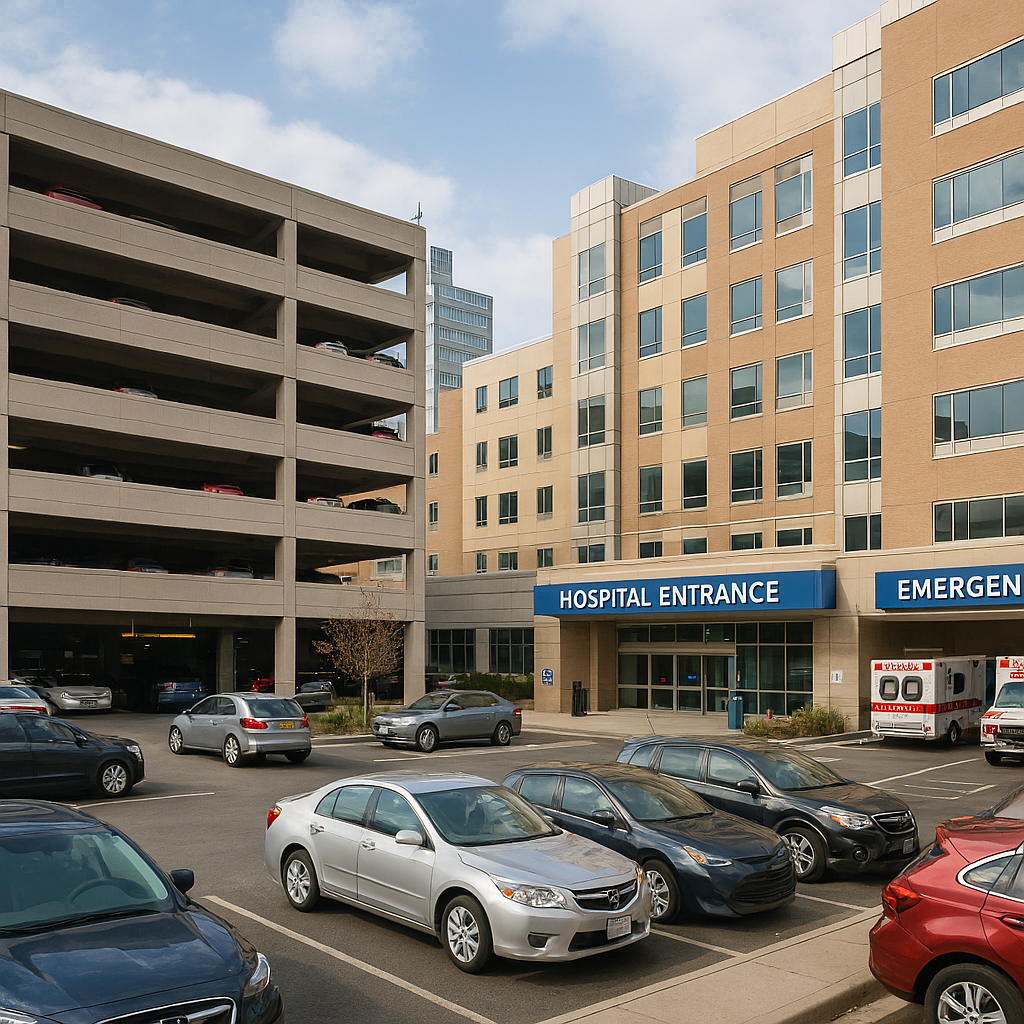
Hospital parking operates under constraints that don’t apply to most commercial facilities. Demand is continuous around the clock. The user mix spans long-term employees, shift workers, short-visit outpatients, families of inpatients who may be staying for days, emergency department arrivals who arrive stressed and need to park instantly, and vendors. ADA requirements are proportionally higher than standard commercial lots. And the stakes for failure — a family missing time with a patient, an employee who can’t get to their shift, an ambulance access point that’s blocked — are higher than in most parking contexts.
Structuring Operations for 24/7 Demand
The first operational decision in hospital parking is segmentation. A facility that treats all users identically will fail all of them. Effective healthcare parking separates:
Emergency department access: A dedicated zone immediately adjacent to the ED entrance, with short-term free or low-cost parking (typically 30–60 minutes). This zone should never be convertible to general use. Access must be visible from the main entry road without signage search.
Patient and visitor parking: The primary revenue-generating zone for transient users. Validation programs are standard — most hospitals validate for the duration of an appointment and charge above that threshold, or provide full validation tied to patient registration. A robust parking validation system integrated with the hospital’s patient management system can automate validation issuance and reduce front-desk overhead.
Employee permit zones: Typically located on the perimeter of the campus or in upper levels of a structure. Employee programs generate predictable base revenue and keep core visitor zones available for patient access. Permit tiers by role (physician, nursing, administrative, support staff) with corresponding pricing are standard at larger institutions.
Valet Operations and Validation Programs
Valet parking for patient drop-off is increasingly standard at major medical centers, particularly at main entrances. Valet serves patients who cannot walk long distances from a garage and reduces the search traffic that congests main entry lanes. Effective valet programs are staffed for peak admission hours (typically 8–11am) with clear handoff protocols for overnight vehicle storage.
Validation programs are essential for visitor satisfaction and staff efficiency. When validation requires a staff member to manually stamp or authorize a ticket, you’re consuming clinical and administrative time on parking administration. Systems that allow nurses or registration staff to issue validation via a tablet app, or that tie validation to appointment check-in automatically, significantly reduce this overhead. Mobile validation via QR code is particularly effective in hospital environments where visitors often pay while still at the bedside.
ADA Requirements and Real-Time Occupancy
Outpatient healthcare facilities face higher ADA accessible space requirements than standard commercial parking — a minimum of 10% of total spaces must be accessible (vs. the standard 2% for lots over 500 spaces). Given that many hospital patients have mobility limitations even if they don’t hold permanent disability placards, the effective demand for accessible spaces often exceeds the ADA minimum. Plan for accessible space counts at 12–15% of total capacity in healthcare settings.
Real-time occupancy information is particularly valuable in hospital environments for two reasons. First, emergency vehicles need to know that access aisles and fire lanes are clear — camera-based monitoring systems provide this visibility to facility management without requiring physical patrol. Second, staff arriving for shift changes need to know where open spaces are quickly, particularly in large multi-structure campuses. Occupancy guidance signs at garage entries that show available spaces by level reduce the time-on-site required to find a space.
For a broader look at how LPR technology supports campus access control in healthcare environments, see our article on LPR camera common pitfalls.